What Is Packaging?
YORULMAZ AMBALAJ · INFORMATION GUIDE
What is packaging?Protects the product,
.
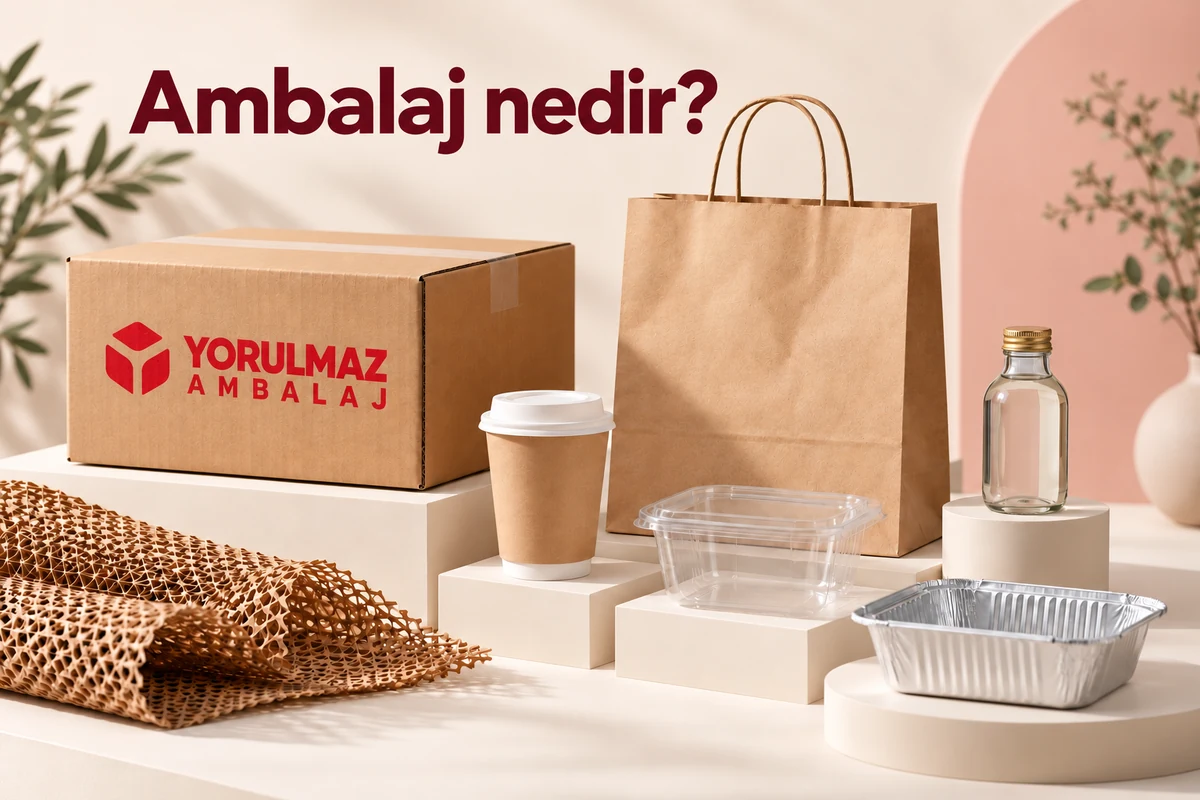
Packaging; It is a material or system used to contain, protect, transport, store, present and provide information about a product. A coffee cup, food container, glass jar and cargo box are examples of packaging that meet different needs.
BASIC INFORMATION
What is packaging used for?
The success of packaging is not only measured by its appearance. It is also important in what condition the product reaches the customer and how easily it can be used.
Packaging is more comprehensive than the box surrounding a product: the container, lid, inner protection, label and transport arrangement can work together. For example, in a cake order, the base, box height and layout that reduces tipping during transportation are different parts of the same need.
Protects the product
Provides appropriate protection for the product against impact, crushing, leakage and external effects. The level of protection depends on the material, design and conditions of use.
Regulates transportation
Keeps products together; It facilitates storage, stacking and shipping processes. Accurate measurement reduces unnecessary space.
Provides information and presentation
It helps to recognize the product, read usage information and make the brand appear consistent. Easy opening and closing is also part of the experience.
THE JOURNEY OF THE PRODUCT
Packaging types: primary, secondary and tertiary packaging
This distinction explains the function of the packaging. The same material can undertake a different task depending on where it is used.
Primary packaging
It constitutes the sales unit offered to the end user. A beverage bottle or the box of a product sold to the consumer can be an example. Direct contact with the product is not necessary in all cases.
Secondary packaging
Groups multiple sales units. An example is the outer package that holds six beverage bottles together; The product itself does not change when removed.
Tertiary packaging
Makes transportation and handling easier. Cartons and fixing materials on the pallet can work together during shipment.
Source: EUR-Lex — definitions of packaging and types of packaging (PDF, Article 3)
What do flexible, rigid and composite packaging mean?
Flexible packaging Easily shaped structures such as films, sachets and bags; hard packaging describes structures that maintain their shape, such as bottles, jars and rigid containers. Composite packaging is the combination of different materials in layers. These are different classifications from sales, grouping and transportation.
KNOW THE MATERIAL
What are the packaging materials?
The material name is a beginning; The thickness of the product, layers, cover and manufacturer's instructions determine the final choice.
| Material | Examples | Feature to be evaluated | Control during election |
|---|---|---|---|
| Paper and cardboard | Cardboard box, paper bag, parcel | Printing, folding, design and stacking according to product size. | Check coating or barrier structure for moisture, oil and liquid contact. |
| Plastic | Containers, bottles, glasses, films and bags | Lightness, different shapes, cover and volume options. | Materials such as PET, PP and PE do not have the same properties; Follow the instructions for use. |
| Glass | Bottle and jar | Reusable container systems for visibility of content and suitable products. | Consider instructions regarding breakage, weight, lid compatibility, and temperature changes. |
| Metal | Aluminum container, can and foil | Shaping, light barrier and bearing resistance according to the product. | Verify suitability for food type, coating and heating method individually. |
| Wood | Crate, crate and pallet | Support in cargo transportation and shipment of large products. | Choose according to the characteristics of moisture, surface, connections and the load to be transported. |
| Multi-layered structures | Beverage carton, coated bowl, laminated bag | Using different properties of more than one material together. | Layer structure can affect both usage and post-use separation. |
You can swipe right in the table on the small screen. You can focus on the table area on the keyboard and use the arrow keys.
PRACTICAL CHECK
How to choose the right packaging?
Answering the following six questions before purchasing will reduce inappropriate size and material choices.
- Describe contentFood, cosmetics or textiles? Whether it is liquid, dry, oily or breakable changes what properties you look for.
- Determine actual sizeVolume and external size are different. Measure the height of the product, the lid closing area and, if necessary, the internal protection allowance.
- Write the terms of useCompare conditions such as filling temperature, holding time, cooling or heating process with the technical data of the product.
- Try flipping and closingSimilar diameter alone may not be sufficient. Series, model, lock structure and cover inclusion should be checked.
- Consider the mode of transportHand carrying, courier or cargo creates different needs. Plan the stacking, external case and internal layout together.
- Compare total costConsider container, cover, inner protection, label, labor and delivery costs together. Don't just look at the package label price.
Example: Does a 500 ml container alone provide sufficient information?
No. The height, mouth size, material and lid of two containers of the same volume may be different. The expected performance for salad, hot food and dessert is also not the same. Compare the intended use first, then the volume and lid compatibility.
FOOD PACKAGING
Food packaging selection and label information
In food packaging, the intended use and technical suitability should be evaluated as well as appearance.
Check suitability for contact
Suitability for food contact materials is evaluated together with the product inside and the condition of use. Migration, which means the passage of substances from packaging to food, is one of the issues taken into account in this evaluation.
Read temperature and time together
Suitability for microwave, freezer or hot filling is not assumed based on the material name. Follow the usage and temperature instructions provided by the manufacturer for the relevant product; Also check the cover.
Source: EFSA — food contact materials
Source: Ministry of Agriculture and Forestry — correct use of food contact materials
What information is found on the packaging?
The information on the empty package is not the same as the label of the packaged food. Food labels include topics such as product name, content, allergen, net amount, date, storage and operator information. What information is mandatory; The product is evaluated according to its presentation style and relevant exceptions.
It would not be correct to say that there will be a "TSE certificate" or "expiration date" on every package. While preparing the prepackaged food label, the current Turkish Food Codex and product-specific regulations should be examined together.
Source: Ministry of Agriculture and Forestry — food labeling guide
THINK ABOUT AFTER USE
How to evaluate sustainable packaging?
Instead of saying "the most environmentally friendly" for a single material under all circumstances, it is more meaningful to evaluate the entire usage cycle of the packaging.
Reduce unnecessary material
Choose the size suitable for the product; Reduce excess white space and unnecessary layers. A reduction that reduces protection performance and increases product loss may not yield good results.
Plan for reuse
In systems designed for reuse, consider the number of cleaning, collection, transportation and use together. Do not consider a disposable container to be reusable per se.
Investigate parsing path
Material, coating, contamination and local collection system affect the result. “Recyclable” does not mean the same thing as “actually recycled.”
Biobased, biodegradable and compostable are not the same thing
Biobased means that the raw material comes partially or completely from biological sources. Biodegradable material can be degraded by biological processes under defined environmental conditions. Compostability relates to specific composting conditions; Suitability for an industrial facility does not mean home compostability.
These statements do not justify releasing a product to nature. Check the declaration of the product, the conditions under which it is valid and whether the appropriate collection system is available in your area. Do not establish environmental superiority for paper, glass, plastic or bioplastic based on material name alone.
Source: European Environment Agency — biodegradable and compostable plastics
Source: European Commission — biobased materials and life cycle approach
Read data in its correct context
2019 · Global plastic production
2019 production amount included in the evaluation published by OECD in 2022.
2019 · Global plastic waste
Share of plastic waste actually recycled after recycling losses, according to OECD.
These numbers do not only belong to the packaging or Turkey; It should not be read as a current rate for 2026.
FUNCTION AND APPEARANCE
How does packaging design contribute to the brand?
Good design presents the product clearly and makes it easier to use. Brand color, text, size and opening experience should be considered together.
Readable information
Let the product name and basic features be distinguished at first glance. Don't let the writings get lost on the ground; The area of mandatory information should be planned at the beginning of the design.
Consistent brand language
Let the logo, color and text layout give the feeling of the same family on different products. Don't make the product difficult to recognize for the sake of a fancy look.
Easy to use
Try the steps of opening the lid, moving, pouring and closing again if necessary. A nice-looking box also needs to close correctly.
A little check before printing
Get a real size trial print. Check the legibility of the logo and small print, cut-fold lines, cover combination and product placement. A design that looks good on the screen may look different when folded.
DEVELOPMENT AND INNOVATION
From traditional containers to smart packaging
In the development of packaging, protection, ease of transportation and information transfer stand out as common needs.
There are different approaches, ranging from traditional solutions such as baskets, pottery and wooden containers to glass, metal, cardboard, plastic and multi-layered structures. Today, these materials have not completely replaced each other; They are used together according to the needs of the product.
Let's distinguish between active, smart and connected packaging
Active packaging
It functions to protect or improve the conditions of the environment where food is stored. For example, oxygen scavenger components may be used in certain applications.
Smart packaging
Provides information about the condition of the food or its environment. Time-temperature indicators can be examples of this; The meaning of the indicator should be read in its own operating instructions.
Linked packaging
Provides access to usage information, content or traceability record with QR code or digital identifier. The presence of a QR code alone is not a freshness sensor or security guarantee.
Source: EFSA – active and intelligent food contact materials
CONCEPTS
Short packaging glossary
Common terms to make comparing product descriptions easier.
- Volume
- Internal capacity of the container; It is usually expressed as ml or cc. 1 ml = 1 cc. It is not the same as external measurement.
- Size
- Measurements such as width, length and height. When choosing a cover or box, check the distinction between internal and external dimensions.
- Barrier
- Resistance against effects such as moisture, gas and light. It is important against which effect it is measured.
- Migration
- Migration of components in packaging or contact material into food. It is considered in the food contact suitability assessment.
- Weight and thickness
- You may encounter measurements such as g/m² on paper and microns on films. Read the unit of measurement according to the product type.
- Lamination
- Merging layers. The resulting structure may behave differently than the properties of a single material.
- Quantity per package
- Number of products in a sales package. It should not be confused with the number of packages in the box.
- Stacking
- Placing products on top of each other. Container-lid shape, load and transportation conditions are evaluated together.
QUESTIONS
24 frequently asked questions about packaging
Short and understandable answers from description to material selection, from design to after use.
Basic concepts
What is packaging and how is it briefly defined?
It is the material or system used to protect, hold together, transport and present the product. Providing information about the product and providing ease of use are also among the duties of the packaging.
Are packaging and packaging the same thing?
Can be said interchangeably in daily use. In technical terms, packaging refers to the material or structure used, and packaging refers to the process of preparing and closing the product with this structure.
Does the primary packaging always come into contact with the product?
No. Primary packaging relates to the sales unit; Defining it only as direct contact would be incomplete. It is necessary to separately evaluate the material in contact with the product.
Is a paper box considered secondary or tertiary packaging?
This depends on the function of the box. Secondary if grouping products for sale; If it is used for shipping and handling purposes, it can be considered as transportation packaging. Classification is not determined by material alone.
Are flexible packaging and bag packaging the same?
Sachets are examples of flexible packaging; However, flexible packaging covers a broader group such as films, wraps and different bag structures. The layer and closure style vary depending on the product.
What does composite packaging mean?
It is a structure in which different materials such as paper, plastic or metal are used together in layers. Layers can take on separate functions; Usage and separation information should be evaluated for the entire structure.
Product selection and use
Which packaging should I choose for hot food?
Select the product whose suitability for hot food and planned contact time is indicated. Check the container and lid together. Just the name of the material or its appearance does not mean that it is suitable for hot use.
Does writing PP or PET mean it is microwaveable?
No. The material abbreviation alone is not a microwave use permit. For the relevant packaging and its cover, if any, refer to the manufacturer's instructions for use.
Can kraft containers be used in liquid foods?
Varies depending on the product. Inner coating, joints, cover and usage temperature are decisive. Do not accept that every kraft-looking container is suitable for liquids such as soup or sauce.
Will the same lid fit containers of the same volume?
Does not always fit. Mouth size, edge shape, series and lock system may differ. Check the container-lid product codes or manufacturer's compatibility information next to the volume.
Does the leak-proof container alone protect the product in cargo?
Sealing and impact and crush resistance are different features. Also plan the outer carton, inner protection, layout and closure layout for the cargo; Try proper handling with full product.
What information is mandatory on the packaging?
Varies depending on product group and presentation style. The information obligations of empty packaging and prepackaged food are not the same. While preparing the food label, the Ministry's current guide and relevant product regulations should be examined together.
Environment and after-use
Which is the most environmentally friendly packaging?
There is no single answer for every usage. The amount of material, product protection, transportation, reuse and local waste collection opportunities should be evaluated together. Just having paper, glass or plastic will not give results on its own.
Does biobased packaging naturally biodegrade?
Not necessarily soluble. Being biobased refers to the source of raw materials; Biodegradability is a different feature. Check the conditions specified by the product and the instructions for collection after use.
Can I compost compostable packaging at home?
Industrial compostability does not imply suitability for home composting. Review the product declaration, relevant verification, if any, and acceptance requirements for the collection or composting system to be used.
Can all Kraft packaging be recycled?
This generalization is not true. Features such as coating, material composition and food contamination, as well as acceptance conditions of local facilities, should be evaluated. Decisions cannot be made based on brown appearance alone.
Does the recycling code indicate that the packaging is recycled?
No. Material identification and actual recycling are different matters. Packaging must be appropriately collected, sorted and processed at the relevant facility.
Can I reuse a disposable food container?
Do not treat a disposable product as a container designed for reuse. Choose a product that complies with the manufacturer's cleaning, temperature and usage instructions.
Design and purchasing
How can I reduce packaging cost?
Reduce unnecessary bulk and excess layers; Consider working with common cup-lid series. Add wastage, cover, parcel, labor and delivery to the comparison. Don't cut costs by sacrificing protection and compliance.
What should I decide first in packaging design?
First, clarify the product's size, usage and what information will be included. Then design the structure, opening style, logo, color and text hierarchy. Check actual size sample before printing.
Are smart packaging and QR code packaging the same?
Not always. Intelligent systems can provide information about the product or environmental conditions. QR code is mostly a way to access digital content; It alone does not measure the freshness of the product.
How do I compare the number of packages and boxes when buying wholesale packaging?
First find the total number of products: multiply the quantity in the package by the number of packages to be purchased. Check if components such as a cover are included. Then compare the unit cost of products with equivalent features.
How should I store the packaging materials?
Follow the manufacturer's storage conditions. Keep packaging in a clean and tidy area; Stack to prevent crushing and contamination. Protect surfaces that will come into contact with food from unnecessary contact before use.
Which product groups can I look at at Yorulmaz Ambalaj?
You can examine the categories of cups, food containers, aluminum containers, paper products, bags and disposable service products. Check the relevant product page for current size, package content, price and stock information.
FROM KNOWLEDGE TO SELECTION
Examine the packaging that suits your needs
Evaluate the information in the guide together with the measurement and usage descriptions on the product pages.
Glass types
Compare size, material and lid options for your beverage presentation.
Explore the categoryFood and carrying containers
Consider portion, usage temperature and lid compatibility together.
Explore the categoryAluminum products
Examine the usage descriptions of the container and tray options.
Explore the categoryBags and sachets
Explore size options according to your transportation and packaging needs.
Explore the categoryCONTINUE READING
Related guides and products
YORULMAZ AMBALAJ
Let's clarify your needs together.
Share the size of your product, its intended use and the quantity you need. You can contact us to compare the available options.